





Forty new tills arrive in Madrid on Monday, your Barcelona stores need the same kit by Friday, and your IT team sits in London, Chicago or Singapore. So who actually plugs it all in?
On-site IT support in Spain means local, certified engineers who handle break-fix, EPOS installs, IMAC work and network jobs at your sites, usually under a 4-hour SLA in Madrid and Barcelona and next business day elsewhere. For multi-store retail rollouts, the best results come from site surveys, pilot stores, centrally staged kit, early CAE paperwork for shopping centres and Verifactu-ready tills.
In this blog, we are going to break down how the two hubs differ from each other, the Spanish rules that trip up foreign teams, and a rollout playbook you can actually use.
What Does On-Site IT Support in Spain Cover?
Remote tools fix a lot, but they can’t reseat a cable, swap a receipt printer or bolt down a self-checkout. That’s the gap field engineers in Spain fill. A typical scope looks like this:
- Break-fix and hardware swaps: laptops, servers, switches, printers and payment devices, with parts shipped to site.
- EPOS support in Spain: till installs, PIN pad swaps, scanner and printer faults, plus kiosk and self-checkout repairs.
- IMAC work: installs, moves, adds and changes across stores, offices and stockrooms.
- Network jobs: Wi-Fi access points, cabling, router and firewall swaps, and wider network and IT infrastructure work.
- Deskside help: hands-on end-user support for head office and regional staff.
- Data centre smart hands: rack and stack, patching, reboots and audits, mostly around Madrid’s campus cluster.
Good providers triage remotely first and only send an engineer when the fault is physical. That habit alone keeps your support bill sensible.
Why Spain Works as a Two-Hub Market
Spain isn’t one uniform market. IHL Group describes Spanish retail as a set of regional markets tied together by two hubs, Madrid and Barcelona, where most major business activity happens.
The scale makes this worth getting right. IHL puts Spain’s 2025 retail sales at €207 billion, up 4.1% on 2024, and ranks its POS installed base the fourth largest in EMEA.
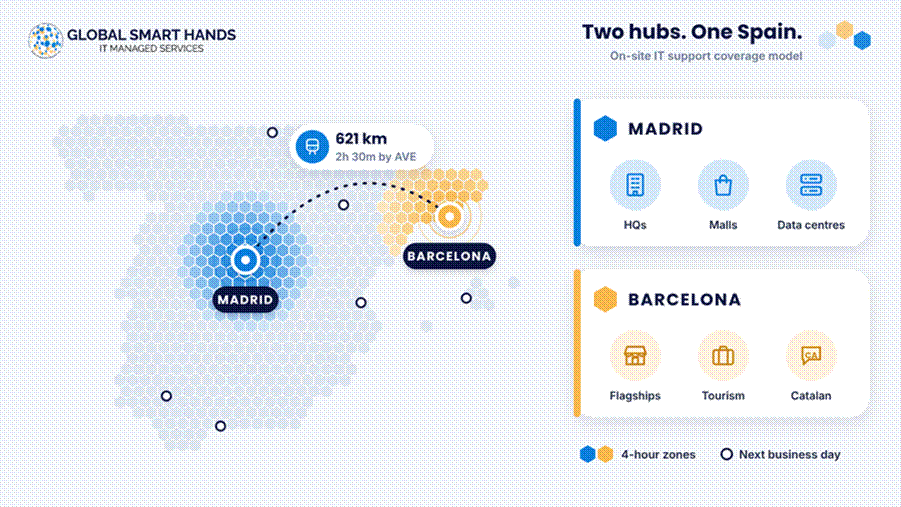
The two cities sit about 621 km apart, roughly 2 hours 30 minutes by high-speed train. That’s close enough to share a spares pool, but far too slow for a 4-hour SLA. You need engineers living in both metros.
Here’s how the two hubs compare for field work:
| Factor | Madrid | Barcelona |
| Typical sites | HQs, flagships, large malls, data centres | Flagships, high street, tourist retail, malls |
| Trading hours | Full freedom to open Sundays and holidays | Sunday and holiday openings follow a set calendar |
| Best install window | Overnight, since many stores trade seven days | Closed Sundays and holidays, plus overnight |
| Language on site | Spanish | Spanish and Catalan |
| Key watch-outs | Mall CAE portals, data centre access rules | Catalan consumer rules, tourist peaks |
IT Support in Madrid: Retail, HQs and Data Centres
Madrid mixes corporate headquarters, big shopping centres and one of Europe’s fastest-growing data centre corridors. Cushman & Wakefield ranks Madrid the fifth primary data centre market in EMEA, with 538 MW of capacity today and a possible 1,105 MW by 2030.
Retail brings its own quirk. The Comunidad de Madrid gives shops full freedom to open on Sundays and holidays, so many stores never truly close. Plan installs overnight and agree access with mall security well before the date.
IT Support in Barcelona: Flagships, Tourists and Catalan Rules
Barcelona leans on flagship stores and visitor footfall. Spain welcomed a record 96.8 million international tourists in 2025, and Catalonia drew the most of any region, at nearly 20.1 million.
Two local rules matter on site. Catalonia’s Consumer Code gives shoppers the right to be served in Catalan, and fixed signage and price lists must be at least in Catalan. Check screen templates and receipt layouts before go-live.
Catalonia also limits Sunday trading to a set calendar. That’s good news for you, because closed Sundays hand engineers clean install windows.
The Spanish Rules That Catch Foreign IT Teams Out
This is where generic rollout plans fall apart. Three rules shape almost every store visit in Spain, and none of them appear in a standard runbook.
CAE Paperwork Comes Before the Screwdriver
Here’s the detail most guides miss. Spain’s Royal Decree 171/2004 requires companies sharing a workplace to coordinate health and safety before work starts. Locals call it CAE, short for coordinación de actividades empresariales.
In practice, shopping centres and large retailers run CAE portals. Your provider uploads insurance, risk assessments, training records and engineer IDs, and the centre approves them. Miss one document and security turns your engineer away at the loading bay, with the SLA clock still ticking.
The fix is simple. Pre-register a named pool of engineers per centre weeks ahead, and treat CAE approval as a rollout milestone. Spain’s safety institute INSST publishes practical CAE guidelines if you want the detail.
Verifactu and TicketBAI Are Reshaping Spanish Tills
Spain’s Verifactu regulation sets strict technical rules for billing software, including tamper-proof records and QR codes on invoices. After a further delay, it becomes mandatory on 1 January 2027 for corporate taxpayers and on 1 July 2027 for everyone else.
Software vendors already had to offer compliant versions by 29 July 2025, and the Basque Country runs its own TicketBAI system. So many 2026 and 2027 EPOS refreshes double as fiscal upgrades. Ask engineers to print and check a live test receipt before signing off each store.
Accessibility Rules Now Cover Payment Terminals
Spain’s Ley 11/2023 transposes the European Accessibility Act. Since 28 June 2025, new payment terminals and self-service kiosks must meet accessibility requirements, while older self-service units can stay until the end of their useful life, capped at 20 years.
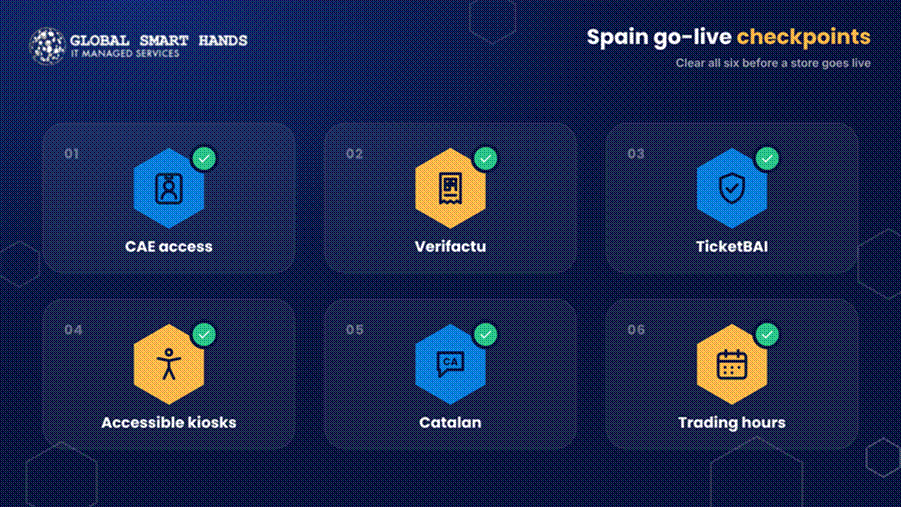
For a rollout, that means checking the model, not just the price, before you order 300 kiosks. Use this quick checklist before any Spanish go-live:
| Rule | What it affects | Check before go-live |
| CAE (RD 171/2004) | Engineer access to malls and shared sites | Engineer documents approved on the centre’s portal |
| Verifactu (RD 1007/2023) | EPOS and billing software | Compliant software version and a live test receipt |
| TicketBAI (Basque Country) | Tills in Álava, Bizkaia and Gipuzkoa | Regionally certified software stack |
| Ley 11/2023 (EAA) | New payment terminals and kiosks | Accessible model and sensible placement |
| Catalan Consumer Code | Signage, screens and receipts in Catalonia | Catalan templates loaded and tested |
| Regional trading hours | Install windows | Store calendar agreed per region |
How to Plan Multi-Store Retail Rollouts in Spain
Spanish retail runs mostly on smaller regional players rather than giant national chains, as IHL points out, so most estates mix formats, franchisees and store sizes. A good retail IT rollout plans for that variety instead of assuming every store looks like the flagship.
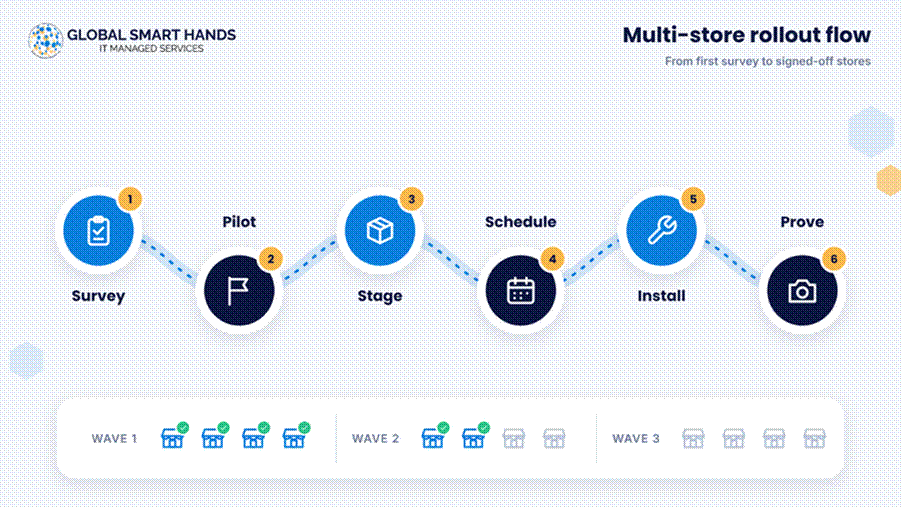
Here’s the sequence we see work best:
- Survey first. Check power, data points, counter depth and comms cabinets before you order kit. Our guide to pre-deployment site surveys explains why this step saves the most money.
- Pilot in both hubs. Run one Madrid store and one Barcelona store, then fix the runbook before wave one.
- Stage centrally. Image, label and test every device at a staging site so engineers install rather than configure.
- Respect the calendar. Avoid the January and July sales, Black Friday and Christmas, plus local holidays like San Isidro (15 May) in Madrid and La Mercè (24 September) in Barcelona.
- Lock in access. Book loading bays, security escorts and CAE approvals for every centre.
- Install in regional waves. Cluster stores so one team covers several sites per night.
- Prove completion. Capture photos, serial numbers and a test transaction per store, then run a week of hypercare.
Self-checkout adds weight to all of this. IHL also notes that Mercadona, Carrefour Spain and Lidl Spain are speeding up self-checkout deployments, which means heavier kit, more power drops and longer install slots. For more on pace, see how smart hands speed up EPOS rollouts across regions.
How to Choose IT Field Services in Spain
Plenty of providers claim national coverage. Fewer can prove it in Zaragoza, Bilbao, Seville or Valencia at 7 a.m. on a Sunday. Ask these questions before you sign:
- Where do your engineers actually live, and what’s the honest response time outside Madrid and Barcelona?
- Do you hold spare parts in Spain, or do they arrive by courier from another country?
- Can engineers work in Spanish, English and, for Catalonia, Catalan?
- Are you already registered on the main CAE portals?
- Have your engineers installed Verifactu or TicketBAI tills before?
- Can you work white-label under our brand?
On price, our 2026 European cost guide puts Southern European on-site rates, Spain included, at roughly €45 to €120 per hour, with emergency premiums on top. It’s also worth reading up on 4-hour SLA standards so you know what a fair commitment looks like.
How Global Smart Hands Supports On-Site IT in Spain
Global Smart Hands is a London-headquartered IT services partner with 5,000+ engineers across 150+ countries, Spain included. Here’s how that maps onto everything above.
Local Engineers Across Madrid, Barcelona and Beyond
GSH delivers smart hands services in Spain across 12 cities, from Madrid and Barcelona to Seville, Valencia, Bilbao and Las Palmas, plus every province including the Balearic and Canary Islands.
Its 24×7 IT support across Spain runs through an English and Spanish-speaking service desk, with 4-hour engineer response in major cities. More than 20 secure stocking locations across Europe, the Middle East and Africa keep replacement parts close to your sites.
EPOS, Retail and Rollout Support
From till swaps to self-checkout faults, the EPOS and retail support team keeps stores trading. Rollout waves lean on IMAC services for installs, moves and changes, and on site surveys before and after deployment.
Flexible Ways to Work Together
You can match the engagement model to each site rather than forcing one contract on everything:
- Resource on SLA for predictable, on-demand dispatch.
- A full-time resource for busy HQs or flagship stores.
- White-label smart hands for MSPs serving their own clients.
Ready to Get On-Site IT Support in Spain Right?
Getting on-site IT support in Spain right comes down to local detail. Madrid and Barcelona each need their own engineers, because 621 km rules out a shared 4-hour SLA. Madrid’s open trading hours squeeze install windows, while Barcelona adds Catalan language duties and heavy tourist footfall.
Across the country, CAE paperwork controls site access, Verifactu reshapes tills from 2027, and accessibility rules now cover new payment terminals. Plan every rollout with surveys, pilots, staged kit and proof of completion, and choose a partner who has done it before.
Ready to support your Spanish stores, offices or racks without flying engineers in? Talk to Global Smart Hands today for a tailored quote and a coverage plan built around your sites.
Frequently Asked Questions
How much does on-site IT support cost in Spain?
Most on-site work in Spain costs roughly €45 to €120 per hour in 2026, depending on city, task and SLA. Emergency or out-of-hours visits typically add 40% to 75% on top.
What does a smart hands technician do?
A smart hands technician acts as your eyes and hands on site. They handle rack and stack, cabling, reboots, hardware swaps, audits and installs under your remote team’s direction.
What is a retail IT rollout?
A retail IT rollout is the planned deployment of technology, such as EPOS tills, kiosks, Wi-Fi or digital signage, across many stores in waves, using standard runbooks, staged kit and sign-off checks.
What is a 4-hour SLA in IT support?
A 4-hour SLA means the provider commits to having an engineer on site within four hours of a logged incident. It usually applies in major cities, with next business day cover elsewhere.