




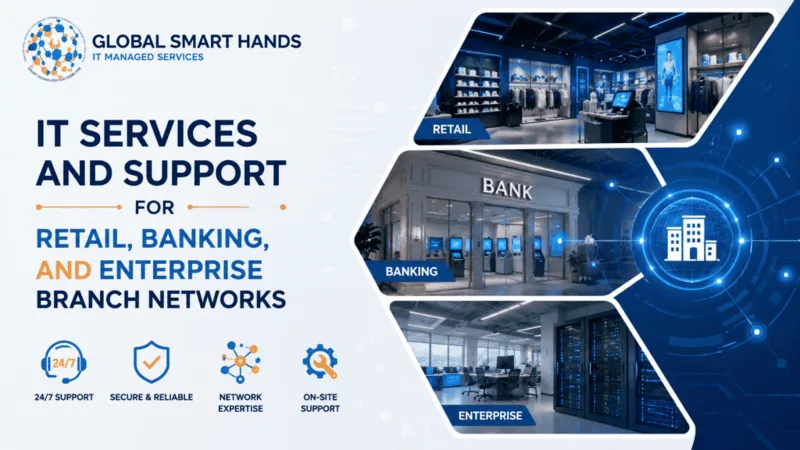
IT services and support for retail, banking, and enterprise branch networks means keeping every till, ATM, teller station, and back-office connection running across dozens (or thousands) of locations at once.
Such systems require a mix of 24/7 helpdesk coverage, on-site field engineers, EPOS and hardware maintenance, network monitoring, and installs-moves-adds-changes (IMAC) work, all delivered against tight response-time agreements so one broken register doesn’t turn into a company-wide problem.
But if you’re actually responsible for a network of branches, whether that’s 12 retail stores, 40 bank locations, or 300 enterprise offices, the real question isn’t “what is branch IT support.” It’s “how do I stop this from falling apart at 2am on a Saturday, in a city where I don’t have a single employee.” In this blog, we are going to discuss everything you need to know about IT services and support for retail, banking, and enterprise branch networks.
What Actually Counts As Branch Network It Supports?
It’s broader than most people assume. A single retail location or bank branch typically depends on:
- EPOS and point-of-sale hardware, including terminals, receipt printers, barcode scanners, and card readers
- Network infrastructure, like routers, switches, firewalls, and Wi-Fi access points that keep the branch connected to head office
- End-user and desktop support for the staff actually working the floor or the counter
- IMAC services (installs, moves, adds, changes) whenever a branch opens, relocates, or upgrades equipment
- Break-fix support for when something physically dies and needs a technician on-site, not a remote reboot
- Site surveys before a rollout, so nobody discovers a power or cabling problem after the hardware has already shipped
The difference between this and “regular” IT support is simple: it’s not one office, it’s dozens of addresses, often in cities where the business has no permanent staff at all. That’s where dedicated network and IT infrastructure services and specialist EPOS and retail support come in, because remote monitoring alone can’t fix a jammed receipt printer or a dead switch.
Why Does This Matter More Now Than It Did Five Years Ago?
Three things changed in the banking retail and enterprise systems which has raised the demand for reliable technical systems over the past few years.
Downtime Became More Expensive
Gartner’s widely cited benchmark puts the average cost of IT downtime at roughly $5,600 a minute, and ITIC’s more recent surveys show over 90% of mid-size and large organizations now report losses above $300,000 an hour when something goes down.
Branch Networks Got Leaner
According to NCRC’s analysis of FDIC branch data, the U.S. banking network contracted by nearly 15% between 2017 and 2025, dropping from 86,469 to 73,649 branches. Fewer branches means every remaining one carries more weight. If it goes dark, there’s no nearby backup for customers to walk into.
Attack Surface Grew
Financial firms are now 300 times more likely to be targeted by a cyberattack than companies in other industries, according to Boston Consulting Group research, and every branch with a network connection is a potential entry point. Keeping systems patched, monitored, and physically maintained isn’t optional anymore.
How Are Retail, Banking, and Enterprise Branches Actually Different?
They all need reliable, distributed IT, but the priorities shift depending on what the branch is actually for:
| Sector | Core IT priority | Typical hardware | Biggest risk if it fails |
|---|---|---|---|
| Retail | Checkout uptime, inventory accuracy | EPOS terminals, printers, scanners, kiosks | Lost sales during peak hours |
| Banking | Security, compliance, transaction accuracy | ATMs, teller terminals, core banking links | Regulatory fines, breach of trust |
| Enterprise branch | Connectivity, employee productivity | Desktops, switches, VoIP, Wi-Fi | Stalled operations, missed deadlines |
A retail chain can usually tolerate a short delay before a technician arrives. A bank branch generally can’t, since compliance and customer trust are on the line the moment a system misbehaves. That’s part of why response-time guarantees matter so much more in finance than in a back-office enterprise setting.
What should you look for in a branch IT support partner?
If you’re comparing providers, run through this checklist:
Physical Coverage That Matches Your Footprint
A partner covering 150+ countries is only useful if they actually have engineers near your branches, not just a sales office.
Written SLAs
A real, written SLA, including how fast someone shows up. Look closely at whether the 4-hour response window applies to major cities only or your specific locations too.
Vendor Limitations
Vendor-agnostic hardware experience can affect things as well. Since your branches probably run a mix of brands and won’t all be replaced at once.
Engagement Models
Flexible engagement models are limited to some extent as well. From full-time dedicated engineers to on-demand, pay-per-visit support.
On-Site Surveys
Pre-rollout site surveys for new locations, so power, cabling, and rack space get checked before hardware arrives, not after.
Reliable Reporting
Reporting you can actually read with dashboards that show ticket history and recurring problem locations.
In-house IT Team or Outsourced Branch Support: Which One Wins?
Honestly, it depends on your scale, but here’s how the trade-off usually breaks down:
| Factor | In-house team | Outsourced field support |
|---|---|---|
| Cost structure | Fixed salaries and benefits, regardless of ticket volume | Pay for what you actually use |
| Coverage hours | Limited to whoever is staffed and where | 24/7, across many time zones |
| Scaling speed | Slow, tied to hiring cycles | Fast, engineers added on demand |
| Skill breadth | Narrow, limited to a handful of staff | Wide, matched to the specific job |
| Best fit for | A handful of nearby locations | Multi-country or multi-state networks |
Most growing businesses don’t pick one model forever. A lot of them blend full-time IT staff with ad-hoc, on-demand support, keeping a core team for strategy while leaning on external engineers for the physical, location-specific work. That’s also why full-time resource allocation through a third party has become such a common middle ground.
What About Security And Compliance Across Branch Networks?
Retail and banking branches both handle regulated data, just under different rulebooks:
- Retail generally has to stay PCI DSS compliant for anything touching card payments
- Banking deals with a heavier stack, often including regional data protection law like GDPR, plus sector-specific financial regulation
- Enterprise branches in multiple countries have to juggle whichever local data laws apply wherever the office happens to sit
None of this is only a software problem. Firmware updates, physical access control, and correctly decommissioned hardware all matter just as much as firewall rules. Banks in particular are learning to manage this at scale; see how larger institutions are approaching IT management across international branches as they balance uptime with regulatory pressure.
How does Global Smart Hands help with retail, banking, and enterprise branch networks?
This is where Global Smart Hands comes in. The company is a UK-headquartered international IT support provider with delivery teams across London, Pakistan, and India, and field engineers reaching more than 150 countries.
For businesses running distributed branch networks, that global bench of over 5,000 engineers means a technician can usually be dispatched without the client keeping full-time staff in every city.
In practice, that support covers a few specific areas that map directly onto everything above:
- EPOS and retail support for chains that need consistent uptime across multiple store locations, including installs, upgrades, and swift hardware swaps
- IMAC services for banks and enterprises opening, relocating, or upgrading branch equipment without a lengthy internal project team
- Resource on SLA and full-time resource allocation, so a business can scale support up or down instead of committing to permanent local hires
- 24/7 international coverage, with a general 4-hour engineer dispatch target in major cities, backed by round-the-clock support rather than standard office hours
If you require more reliable IT support services and retail support services, contact Global Smart Hands today. Share your requirements to learn how we deliver quality of IT support services in more than 150+ countries.
Frequently Asked Questions
What is smart hands support in IT?
Smart hands refers to on-site technicians who physically handle tasks a remote helpdesk can’t, like replacing hardware, running cables, or rebooting equipment in a data center or branch, usually dispatched under a service agreement.
How fast should an engineer respond to a branch outage?
It depends on the industry and location, but a 4-hour on-site response in major cities is a common benchmark for retail and banking, since longer delays start directly costing sales or compliance standing.
Is outsourced branch IT support cheaper than an in-house team?
Usually yes, for multi-location networks, since you’re not carrying full salaries, benefits, and idle time for staff in every city. In-house teams tend to make more sense when locations are few and clustered close together.
What does IMAC mean in IT services?
IMAC stands for Installs, Moves, Adds, and Changes. It covers the physical work involved whenever a branch gets new hardware, relocates equipment, or changes its network setup.
How do retail chains reduce EPOS downtime across stores?
By combining remote monitoring with rapid on-site dispatch, keeping spare parts stocked regionally, and standardizing installation procedures so every store runs the same configuration.
What compliance rules apply to bank branch IT systems?
It varies by region, but banks commonly need to align with data protection law like GDPR, sector-specific financial regulation, and PCI DSS wherever card payments are involved, on top of general cybersecurity hygiene.