


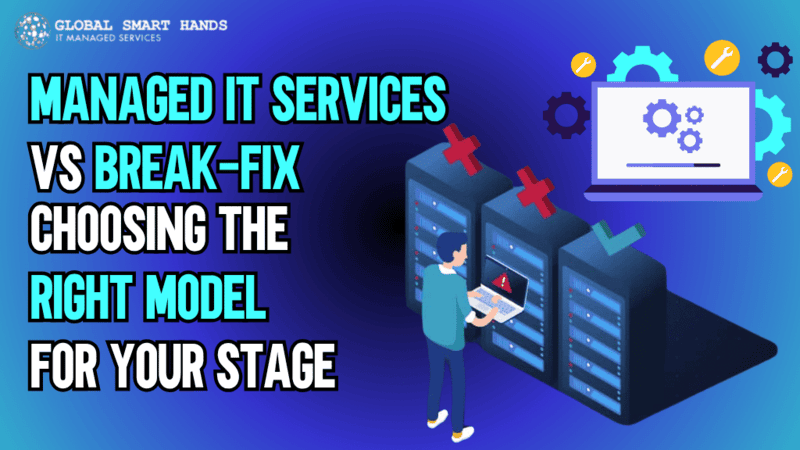
In today’s fast-moving digital world, businesses depend heavily on reliable IT infrastructure services. Whether you’re a startup or an established enterprise, how you manage your IT support can directly impact productivity, security, and growth. Two common approaches dominate the landscape: Managed IT Services and the Break-Fix model.
Choosing between managed IT services vs break-fix isn’t just a technical decision but a strategic one. Each model has its own strengths, costs, and ideal use cases. Understanding which approach fits your business stage can help you reduce downtime, improve efficiency, and better control IT expenses.
What are the Managed IT Services?
Managed IT Services refer to a proactive approach where a third-party provider takes responsibility for maintaining, monitoring, and supporting your IT systems on an ongoing basis. Instead of waiting for problems to occur, managed service providers (MSPs) aim to prevent them.
This model typically involves a subscription-based pricing structure, making costs predictable. Businesses receive continuous monitoring, cybersecurity support, system updates, and help desk services.
Recent industry data highlights the rapid growth of this model. According to a 2025 report by Statista, the global managed services market is expected to exceed $400 billion by 2027, reflecting increasing demand for outsourced IT support services.
Key Benefits of Managed IT Services
Ease of Maintenance
One of the biggest advantages is proactive maintenance. Systems are continuously monitored, which helps detect and fix issues before they escalate. This reduces downtime significantly which is critical for businesses that rely on digital operations.
Predictable Cost
Another benefit is cost predictability. Instead of unexpected repair bills, companies pay a fixed monthly fee. This helps with budgeting and financial planning.
Better Access to Talent Pool
Managed IT Services also provide access to skilled professionals without the need to hire an in-house team. This is especially valuable for small and medium-sized businesses that may not have the resources to build a full IT department.
Cybersecurity
Additionally, cybersecurity services are often included. With cyberattacks increasing globally, Cybersecurity Ventures estimates cybercrime will cost businesses $10.5 trillion annually by 2025.
What is the Break-Fix Model?
The Break-Fix model is the traditional way of handling IT issues. In this setup, businesses call an IT technician only when something breaks. The provider then fixes the issue and charges for the work done.
This approach may seem cost-effective at first because there are no ongoing fees. However, it often leads to unpredictable expenses and longer downtime.
Key Characteristics of Break-Fix Services
Reactive Nature
The most notable feature is its reactive nature. Problems are addressed only after they occur. This can lead to delays in resolving critical issues, especially if the problem is complex or requires specialized expertise.
No Continuous Monitoring
Another aspect is the lack of continuous monitoring. Without regular system checks, small issues can go unnoticed until they become major failures.
Cost Effective
Despite its limitations, the Break-Fix model can still be suitable for certain businesses particularly those with minimal IT needs or very tight budgets.
Managed IT Services vs Break-Fix: A Detailed Comparison
When deciding between these two models, it’s important to look at several key factors.
Cost Structure
Managed IT Services operate on a subscription model, offering predictable monthly costs. Break-Fix, on the other hand, involves paying per incident, which can lead to unexpected expenses.
While Break-Fix may appear cheaper initially, studies show that businesses using reactive IT support often spend 25–30% more annually due to emergency repairs and downtime costs.
Downtime and Productivity
Downtime can be extremely costly. According to Gartner, the average cost of IT downtime is around $5,600 per minute.
Managed IT Services minimize downtime through proactive monitoring and maintenance. Break-Fix models, however, often result in longer outages because issues are only addressed after they disrupt operations.
Security and Risk Management
Cybersecurity is a major concern for businesses of all sizes. Managed service providers typically include continuous security monitoring, patch management, and threat detection.
Break-Fix services usually do not include ongoing security measures, leaving businesses more vulnerable to cyber threats.
Scalability
As businesses grow, their IT needs become more complex. Managed IT Services can easily scale with your organization, offering flexible support and additional services as needed.
Break-Fix models lack this flexibility, making them less suitable for growing companies.
Choosing the Right Model for Your Business Stage
The best approach depends largely on where your business stands in its growth journey.
Startups and Small Businesses
Startups often operate on limited budgets, which may make Break-Fix services appealing. However, as digital reliance increases, even small businesses benefit from proactive IT support.
Managed IT Services can help startups avoid costly disruptions and focus on growth rather than technical issues.
Growing Businesses
For businesses experiencing growth, Managed IT Services are usually the better choice. As operations expand, so do IT demand. A proactive approach ensures systems remain stable and secure.
At this stage, investing in continuous IT infrastructure services can prevent bottlenecks and support scalability.
Large Enterprises
Large organizations typically require advanced IT management, including network monitoring, cybersecurity services, and global support. Managed IT Services are almost always the preferred model here.
When Break-Fix Still Makes Sense
While Managed IT Services offer many advantages, Break-Fix is not entirely obsolete. It can still be useful in certain scenarios.
- Businesses with very limited IT usage or those that rely on simple systems may not need ongoing support. In such cases, occasional repairs may be sufficient.
- Companies with in-house IT teams might use Break-Fix services as a backup for specialized issues.
- As soon as operations become more complex or downtime becomes costly, switching to a managed approach is often a smarter move.
What is the Role of Global Smart Hands (GSH) in Modern IT Services?
When it comes to bridging the gap between Managed IT Services and on-demand support, Global Smart Hands (GSH) plays a crucial role. The company offers a flexible approach that combines the strengths of both models while addressing the limitations.
Global Smart Hands provides on-site IT support in over 150 countries, with a rapid 4-hour response time in major cities. This makes it an ideal partner for businesses with global operations or distributed teams.
24×7 International IT Support
GSH delivers round-the-clock IT support services worldwide. This ensures that businesses can maintain operations without interruption, regardless of time zones.
Full-Time Resource Allocation
Companies can allocate dedicated engineers based on their specific needs. This allows for tailored support in areas such as end-user services, network management, and data center operations.
EPOS and Retail Support
Retail businesses benefit from specialized EPOS support, ensuring minimal downtime and efficient system performance during critical operations.
Service Level Agreement-Based Resources
With GSH, businesses can access skilled professionals within 4 hours, based on customized SLAs. This provides both speed and reliability, which are essential for modern IT environments.
IMAC Services (Installs, Moves, Adds, and Changes)
GSH offers comprehensive IMAC services for data centers and office environments. From hardware installation to system relocation, businesses receive expert assistance with minimal disruption.
Desktop Support Deployment
Global deployment of desktops, servers, and networks is handled by experienced professionals, ensuring cost-effective and efficient setup.
Network and IT Infrastructure Services
Customized network management ensures optimal performance. Businesses can rely on tailored dashboards and monitoring systems designed to meet their unique needs.
End User Support
With support available in over 150 countries, GSH end user support empowers employees with fast and reliable IT assistance, improving productivity and user experience.
Managed It Services VS Break-Fix: Making the Right Choice
Managed IT Services provide a proactive, reliable, and scalable approach, making them ideal for businesses that depend heavily on technology. Break-Fix, while still useful in limited scenarios, often falls short in today’s fast-paced digital environment.
For many organizations, a hybrid approach can offer the best of both worlds. By combining proactive management with rapid on-demand support, businesses can ensure smooth operations and sustained growth.
Ultimately, the right choice depends on your business goals, budget, and IT complexity. But one thing is clear: as technology continues to evolve, having dependable IT support services is no longer optional it’s essential. With reliable partners like Global Smart Hands, you can get the receive the right consultation and technical support. So contact GSH today and choose the right model for your business stage depending on the requirements.
Frequently Asked Questions (FAQs)
Which model is more cost-effective in the long run?
Managed IT Services often prove more cost-effective over time because they prevent issues before they escalate into expensive problems. While Break-Fix may seem cheaper initially, unexpected repairs and downtime can add up quickly.
How does downtime differ between the two models?
Downtime is typically much lower with Managed IT Services due to continuous monitoring and maintenance. Potential issues are identified and resolved before they cause system failures. In the Break-Fix model, downtime can be prolonged because action is only taken after a problem occurs.
Which model is better for small businesses or startups?
Startups and small businesses often benefit from Managed IT Services because they lack in-house IT expertise. The proactive support helps avoid costly disruptions during critical growth stages. However, some very small businesses with minimal IT needs might initially choose Break-Fix to save money.
How does scalability compare between Managed IT Services and Break-Fix?
Managed IT Services are highly scalable, allowing businesses to easily adjust services as they grow. Providers can add new systems, users, or security layers seamlessly. Break-Fix lacks this flexibility since it only addresses issues as they arise.
How do security measures differ between the two approaches?
Managed IT Services include proactive cybersecurity measures such as regular updates, monitoring, and threat detection. Break-Fix providers typically address security issues only after a breach or problem occurs. This reactive stance increases vulnerability.